


Why Choosing the Right Countertop Matters
Durable countertop options are essential for any kitchen that sees regular use. Whether you're cooking daily meals, entertaining guests, or simply enjoying your morning coffee, your countertops take a beating from hot pans, sharp knives, spills, and daily wear and tear.
Here are the most durable countertop materials ranked by resilience:
- Ultra-Compact Quartz (Dekton, Neolith) - Extremely resistant to heat, scratches, and stains
- Engineered Quartz - Non-porous, low maintenance, highly scratch and stain resistant
- Quartzite - Natural stone with exceptional hardness and durability
- Granite - Heat and scratch resistant, requires periodic sealing
- Porcelain Slabs - Scratch and stain resistant, lightweight but can chip
- Soapstone - Excellent heat resistance, softer but easily repairable
- Solid Surface - Stain resistant and repairable, less heat resistant
The kitchen is often called the heart of the home for good reason. It's where you prep meals, gather with friends, and create lasting memories. That's why selecting a countertop that can withstand the demands of daily life is so important.
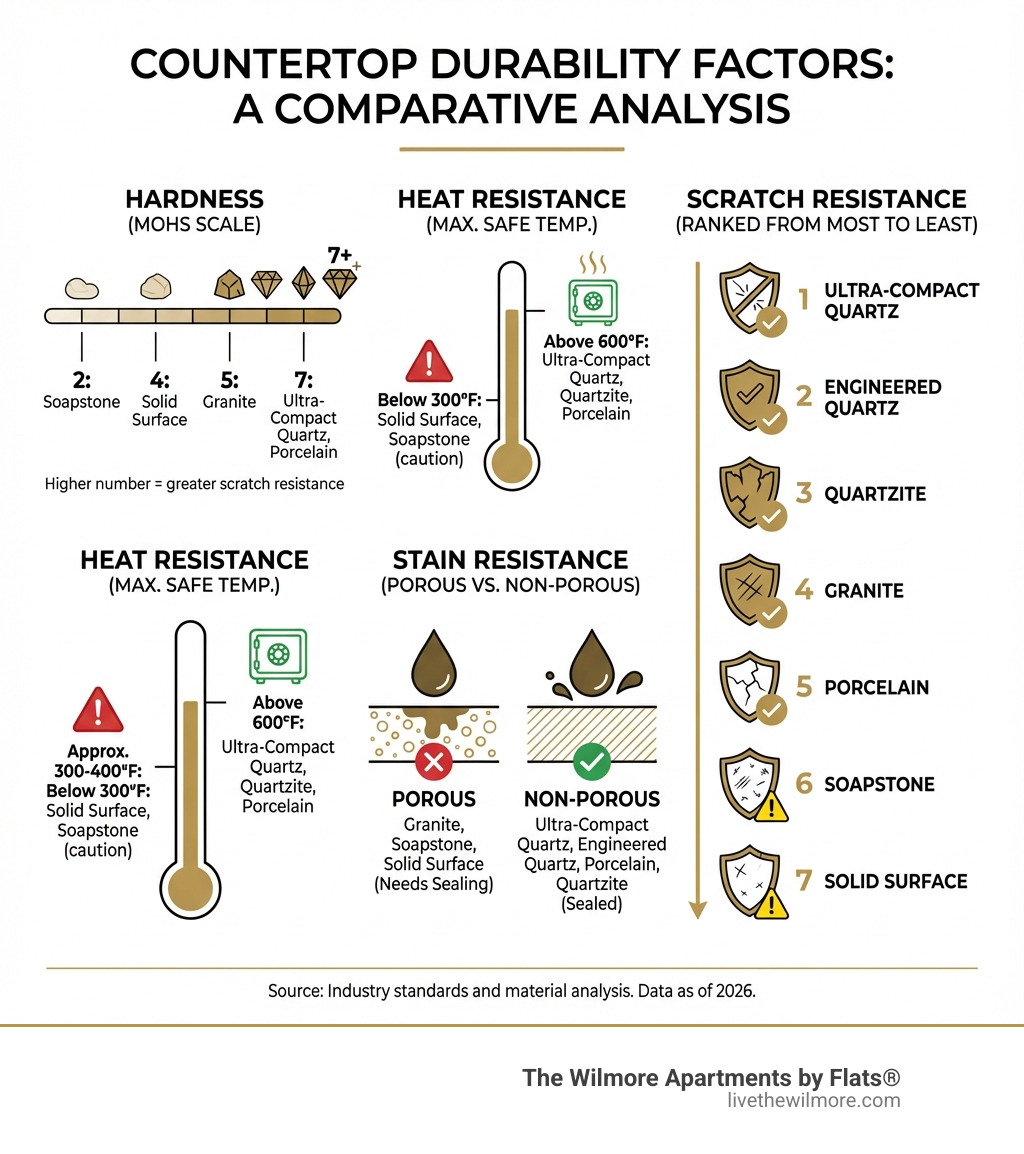
What makes a countertop truly durable? It comes down to five key factors: hardness (resistance to scratches), heat resistance (ability to handle hot pans), stain resistance (how well it repels liquids), crack resistance (structural integrity), and maintenance requirements (how much care it needs to stay looking great).
This guide will walk you through the most resilient countertop materials available today, from engineered stone that never needs sealing to natural options that bring unique character to your space.
What Defines a Durable Countertop?
When we talk about durable countertop options, we're not just referring to a single characteristic. True durability is a symphony of properties that allow a surface to endure the rigors of daily life in a busy kitchen. Understanding these factors is key to making an informed choice for your home.
At the heart of a countertop's resilience is its hardness. This refers to its ability to resist scratches, nicks, and abrasions from everyday use. The Mohs Hardness Scale, which ranks minerals from 1 (softest, like talc) to 10 (hardest, like diamond), is a helpful tool here. Materials higher on this scale will naturally be more scratch-resistant. For instance, quartz ranks around 7 on the Mohs scale, making it highly resistant to scratches, whereas softer stones like soapstone or marble are lower.
Next up is heat resistance. Imagine pulling a piping hot pot straight from the stove and placing it directly on your countertop. A truly durable material should be able to withstand this without scorching, melting, or cracking. While many materials boast heat resistance, some are more heat-proof than others, capable of handling extreme temperatures without a second thought. For materials that aren't completely heat-proof, using trivets is always a wise practice.
Scratch resistance goes hand-in-hand with hardness. A surface that can shrug off accidental knife slips or the drag of heavy appliances will maintain its pristine appearance for much longer. Some materials, like granite, are incredibly tough, earning a reputation for being second only to diamonds in terms of scratch resistance.
Then there's stain resistance. Our kitchens are battlegrounds for spills – coffee, wine, oils, and acidic foods. A non-porous surface naturally repels liquids, preventing them from seeping in and leaving unsightly marks. Porous materials, on the other hand, require regular sealing to create a protective barrier against stains. The easier a countertop is to clean and the less it absorbs, the more stain-resistant it is.
Porosity is a crucial factor here. Materials like granite and marble are naturally porous, meaning they have tiny microscopic holes that can absorb liquids. Engineered materials, by contrast, are often non-porous, making them inherently more resistant to stains and bacteria.
Impact resistance refers to how well a countertop can withstand blunt force without chipping or cracking. Dropping a heavy pot or a ceramic dish can test a countertop's mettle. Some materials are more brittle than others, making them more susceptible to impact damage, especially along edges.
Finally, long-term wear encompasses all these factors over time. A durable countertop isn't just tough on day one; it's tough year after year, maintaining its functionality and aesthetic appeal with appropriate maintenance. Choosing a material that excels in these areas means less worry and more enjoyment in your kitchen for years to come.
Engineered Stone: The Pinnacle of Performance

When it comes to durable countertop options that combine cutting-edge technology with stunning aesthetics, engineered stone truly shines. These materials are designed for modern living, offering a host of advantages that make them a top choice for busy households in Chicago and beyond.
The primary engineered stone advantages stem from their composition. Unlike natural stone, which can have inherent variations and vulnerabilities, engineered stones are created under controlled conditions. This process results in surfaces that are consistently non-porous, incredibly strong, and remarkably uniform in pattern and color. This means you get a countertop that not only looks fantastic but also performs exceptionally well.
One of the biggest draws of engineered stone is its non-porous surfaces. This characteristic makes them highly resistant to stains, bacteria, mold, and mildew, which is a huge plus for kitchen hygiene. Spills simply sit on the surface, making cleanup a breeze. This non-porous nature also means these countertops require virtually no sealing, contributing to their low maintenance appeal. We understand that our residents at The Wilmore Apartments appreciate finishes that simplify their lives, and engineered stone certainly delivers.
Furthermore, engineered stone offers consistent patterns and a vast array of design options. If you're looking for a specific look, whether it's a solid color, a subtle speckle, or a dramatic veining that mimics natural marble, you'll find it in engineered stone. This consistency ensures that the countertop you choose will look exactly as you expect, from one slab to the next, allowing for seamless integration into your kitchen design.
To learn more about how these modern materials improve living spaces, you can explore our apartments with quartz countertops.
Engineered Stone: Low-Maintenance Durable Countertop Options
Among engineered stones, Quartz stands out as a highly popular and incredibly durable choice. Composed primarily of crushed quartz (often around 94% of the material) bound together with polymer resins and pigments, quartz countertops are a testament to human ingenuity. Quartz is one of the hardest minerals on Earth, and when bonded with these resins, it forms an incredibly hard surface that resists common forms of damage.
This unique composition grants quartz exceptional scratch resistance and chip resistance. It can withstand the daily abuse of kitchen tools and activities without easily showing wear. Its non-porous nature also makes it highly stain resistant, meaning that spills from coffee, wine, or cooking oils are far less likely to penetrate and cause permanent marks. This makes cleaning incredibly straightforward – usually just a wipe with warm water and mild soap is all that's needed.
Beyond its brawn, quartz offers a wide color variety and an extensive range of patterns. From vibrant solids to intricate veining that beautifully replicates natural stone, quartz can complement any design aesthetic. This versatility allows us to offer stunning and practical kitchens in our luxury apartments.
However, it's important to note its heat sensitivity. While quartz is heat-resistant up to around 400°F, the resins used in its construction can be damaged by extreme heat or sudden temperature changes. Placing extremely hot pots or pans directly on the surface without a trivet can lead to scorching, discoloration, or even cracking. So, hot pads are indeed your friends if you have quartz countertops!
Ultra-Compact Surfaces: The Next Generation of Durability
Pushing the boundaries of engineered stone even further, Ultra-compact quartz surfaces represent the next generation of durability. Often referred to as sintered stone, these innovative materials are created from a sophisticated blend of glass, porcelain, and quartz fused under immense pressure and heat, mimicking the metamorphic process that forms natural stone over millennia.
Brands like Dekton and Neolith are pioneers in this category, renowned for their extreme durability. They are often described as "virtually indestructible" and are known for being exceptionally scratch resistant, stain resistant, and even heatproof. This means you can place hot pans directly on the surface without worry, making them ideal for the busiest of kitchens.
In addition to their heat resistance, ultra-compact surfaces are also UV resistant, which means their colors won't fade over time, even with exposure to sunlight. This makes them suitable for both indoor and outdoor applications, offering incredible versatility in design. Their non-porous nature also ensures they are easy to clean and highly hygienic, contributing to a healthy living environment. While these materials can be more expensive and require professional installation, their unparalleled performance and aesthetic appeal make them a top-tier choice for those seeking the ultimate in durable countertop options.
Natural Stone: Timeless Beauty and Brawn

For those who appreciate the raw, unadulterated beauty of the earth, natural stone offers durable countertop options with timeless appeal. These materials bring a unique character to any kitchen, each slab telling its own geological story.
One of the most compelling aspects of natural stone is its one-of-a-kind patterns. No two slabs are exactly alike, featuring distinctive veining, speckles, and color variations that add an unparalleled sense of luxury and individuality to your space. This natural artistry is something engineered materials strive to imitate but can never truly replicate.
Many natural stones boast impressive heat resistance, allowing them to withstand high temperatures without damage. This is particularly true for igneous stones like granite, which are formed under intense heat. However, their durability often comes with certain considerations.
A key factor for most natural stones is sealing requirements. Because they are porous, natural stones need to be sealed periodically to prevent liquids from penetrating the surface and causing stains. The frequency of sealing varies by stone, but it's a necessary step to maintain their beauty and hygiene.
Another important consideration is cabinet support. Natural stone slabs, especially granite and quartzite, can be incredibly heavy. Ensuring your kitchen cabinetry is robust enough to support their weight is crucial for a safe and stable installation. This is a detail our expert installers carefully manage, ensuring structural integrity in all our luxury apartments.
Natural Stone: Classic Durable Countertop Options
Granite remains a cornerstone among durable countertop options, consistently chosen by homeowners for its blend of beauty and resilience. As an igneous rock, formed deep within the earth from molten magma, granite possesses an inherent toughness that makes it an excellent choice for kitchens.
Its composition gives granite remarkable scratch resistance, ranking high on the Mohs scale (typically 6-7), second only to diamonds. This means it can withstand daily cutting and chopping, though using a cutting board is always recommended to protect your knives and the countertop's finish. Granite is also highly heat resistant, making it possible to place hot pans directly on its surface without fear of damage.
However, granite's porosity is a key characteristic to manage. Being a natural stone, it has microscopic pores that can absorb liquids, leading to stains if left unsealed. This is why sealing maintenance is essential. Typically, granite countertops require sealing every 3-5 years, although some darker, denser granites may need it less frequently. Proper sealing creates a barrier that prevents spills from penetrating, preserving the stone's integrity and appearance.
The unique veining and wide array of colors and patterns available in granite ensure that every kitchen can have a distinctive look. From subtle speckles to dramatic swirls, granite offers aesthetic versatility that can complement both traditional and modern designs.
Quartzite: Natural Strength and Elegance
Often confused with engineered quartz, Quartzite is a distinct and highly prized natural stone that offers exceptional durability and a sophisticated aesthetic. This metamorphic stone is formed when sandstone is subjected to intense heat and pressure, changing it into a much harder and denser material.
What makes quartzite particularly appealing is its ability to mimic the neat, often white or grey, look of marble, but with significantly greater resilience. Homeowners seeking marble-like aesthetics without the high maintenance often turn to quartzite. It boasts high durability, ranking around 7 on the Mohs scale, similar to engineered quartz, making it remarkably resistant to scratches and abrasion.
Quartzite is also known for its UV resistance, meaning its colors will not fade even with prolonged exposure to sunlight, an advantage for kitchens with abundant natural light. It is one of the strongest natural stone materials available, making it a robust choice for any kitchen.
While incredibly tough, quartzite is still a natural stone and therefore has some porosity. This means sealing is needed to prevent stains, typically on an annual basis, to protect its pristine surface from spills. With proper care, quartzite offers a beautiful and incredibly resilient surface that adds both strength and elegance to any home.
Beyond Stone: Other Resilient Countertop Choices
While natural and engineered stones often dominate the conversation about durable countertop options, several other materials offer impressive resilience and unique aesthetic qualities. These alternatives provide homeowners with a broader spectrum of choices, each with its own set of advantages for various lifestyles and design preferences. When considering your options for a luxury apartment in Chicago, knowing all the possibilities can help you make the perfect selection.
| Material | Heat Resistance | Scratch Resistance | Stain Resistance | Maintenance |
|---|---|---|---|---|
| Porcelain Slabs | Excellent | Excellent | Excellent | Low (no sealing) |
| Soapstone | Excellent | Moderate | Excellent | Low (oiling for appearance, scratches can be buffed out) |
| Solid Surface | Good | Moderate | Excellent | Low (can be sanded, avoid harsh chemicals) |
Porcelain Slabs
Porcelain slab countertops are a sophisticated and increasingly popular choice among durable countertop options. Crafted from high-quality kaolinite clay and fired at extremely high temperatures, these large format slabs offer a refined aesthetic that can mimic natural stone, wood, or even metal, without the associated upkeep.
The manufacturing process results in an incredibly dense and non-porous material, making porcelain inherently low-maintenance. It requires no sealing, ever, and is exceptionally easy to clean. Beyond ease of care, porcelain boasts excellent heat resistance, allowing hot items to be placed directly on the surface without damage. It is also highly scratch resistant and stain resistant, shrugging off spills and daily wear with grace. Its resistance to water and UV rays further improves its durability.
While porcelain is remarkably tough, one consideration is its potential for chipping along the edges if subjected to a sharp, heavy impact. However, with careful use, porcelain slabs provide a beautiful, hygienic, and highly durable surface that brings a touch of elegance to any kitchen.
Soapstone
For those who appreciate a countertop that develops character over time, Soapstone offers a unique blend of durability and charm. This natural metamorphic stone, characterized by its soft, tactile feel, contains a high percentage of talc, which gives it its distinctive smooth texture.
Despite its soft feel, soapstone is one of the most durable countertop options when it comes to specific challenges. It boasts excellent heat resistance, making it possible to place hot pans directly on the surface without any risk of scorching. Furthermore, soapstone is naturally non-porous, meaning it's inherently stain-resistant and antibacterial, and never requires sealing. This makes it incredibly low-maintenance from a sealing perspective.
However, its talc content also means it's a softer material compared to granite or quartz (ranking 2-3 on the Mohs scale). This makes it prone to scratches and dents. But here's the charming part: these minor imperfections don't detract from its beauty; instead, they contribute to a unique patina over time, giving it a warm, lived-in aesthetic. What's more, scratches are easily repaired by simply buffing them out or applying mineral oil, which also improves its natural dark luster. This ease of repair makes soapstone a surprisingly robust choice for those who don't mind a surface that tells a story.
Solid Surface
Solid surface countertops, commonly known by brand names like Corian, offer a versatile and practical solution for kitchens seeking durable countertop options. These synthetic materials are composed of acrylic or polyester resins combined with minerals, creating a homogeneous, non-porous surface.
One of the standout features of solid surface is its ability to create a seamless appearance. It can be thermoformed into various shapes, allowing for integrated sinks and backsplashes that eliminate visible seams, creating a sleek and hygienic environment. Its non-porous nature makes it inherently stain-resistant and easy to clean, preventing the growth of mold and mildew.
Solid surface is also celebrated for its repairability. Minor scratches can be buffed out with fine-grit sandpaper, restoring the surface to its original condition. This makes it a forgiving option for everyday wear and tear. However, it is not as heat resistant as stone or engineered quartz, so trivets are necessary for hot pans to prevent scorching or melting. While it may not have the hardness of natural stone, its seamless design, wide range of colors, and ease of repair make it a practical and attractive choice for many homes.
Frequently Asked Questions about Durable Countertop Options
Which countertop material is best for a busy kitchen with children?
For high-traffic kitchens, engineered quartz is an excellent choice. Its non-porous surface resists stains from spills, and its hardness makes it highly resistant to scratches and chips from daily activities, ensuring it remains beautiful with minimal upkeep. Its low maintenance requirements also mean less time worrying about cleanup and more time enjoying family moments.
Is quartz or granite more durable?
Overall, quartz is considered more durable for everyday use. While both are very hard and resistant to heat and scratches, the resins in engineered quartz make it non-porous and therefore more resistant to staining, chipping, and cracking than granite. Granite, being a natural stone, is porous and requires periodic sealing (typically every 3-5 years) to maintain its stain resistance, whereas quartz never needs sealing. So, for consistent performance and lower maintenance, quartz often has the edge.
How does professional installation affect a countertop's lifespan?
Professional installation is critical for long-term durability. Proper leveling, secure mounting, and precise seam placement prevent stress cracks and ensure the countertop is fully supported by the cabinetry. This is especially important for heavy materials like natural stone (granite, quartzite) and ultra-compact surfaces, where improper handling can lead to damage during installation or compromise the countertop's integrity over time. A professional installer ensures that the countertop is not only beautiful but also structurally sound, maximizing its lifespan and performance.
Conclusion
Choosing the right countertop for your home is a significant decision, one that balances aesthetic desires with practical needs. As we've explored, durable countertop options is rich and varied, offering solutions that cater to every style and lifestyle. From the unparalleled resilience of ultra-compact surfaces to the timeless charm of natural granite and quartzite, each material brings a unique set of benefits to the table.
Choosing the right material involves understanding your priorities. Do you need a surface that can withstand scorching heat and aggressive chopping without a second thought? Or do you prefer a material that develops a unique patina over time, telling the story of your home? Balancing aesthetics and maintenance is key. Engineered quartz offers consistent beauty with minimal upkeep, while natural stones like granite and quartzite demand a bit more care but reward you with unparalleled natural artistry.
Investing in durability is an investment in your home's future. A robust countertop not only stands up to daily life but also contributes significantly to your home's value and appeal. It’s a foundational element of a well-appointed kitchen, promising years of beauty and functionality.
At The Wilmore, we understand the importance of quality and lasting design in creating exceptional living spaces. We believe that every detail, including your countertops, should reflect a commitment to excellence and comfort.
We invite you to explore our floorplans with luxury apartments to find kitchens designed with both beauty and resilience in mind. Find your ideal apartment with quartz countertops today and experience the blend of sophisticated design and enduring quality that defines our community.