


Why Durable Quartz Countertops Are Changing Modern Kitchens
Durable quartz countertops combine natural strength with engineered precision to create surfaces that resist scratches, stains, and cracks better than most traditional materials.
What Makes Quartz So Durable:
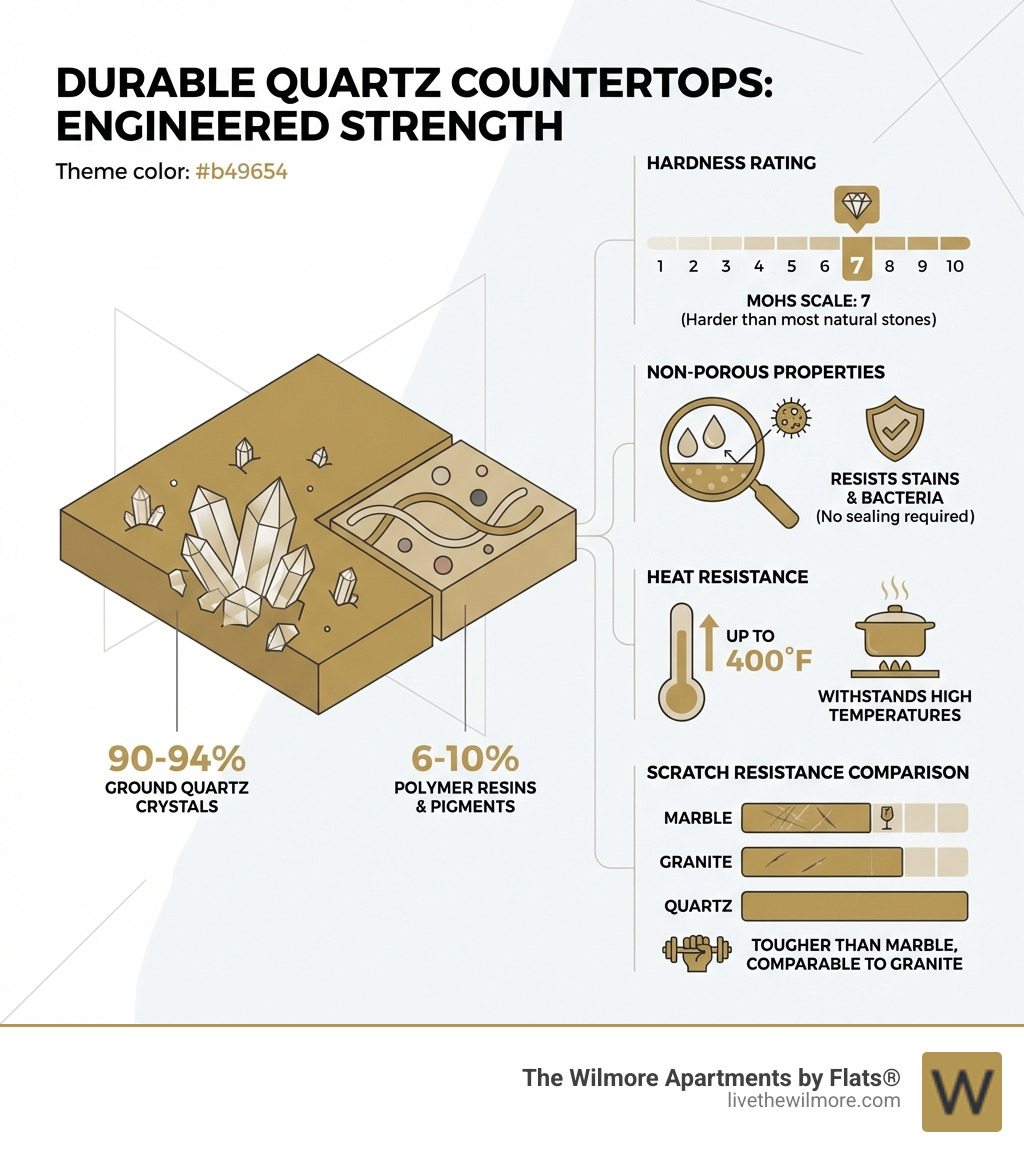
- Composition: 90-94% natural quartz crystals bonded with 6-10% polymer resins
- Hardness: Ranks 7 on the Mohs scale (harder than most natural stones)
- Non-porous: Resists stains and bacteria without sealing
- Heat tolerance: Withstands temperatures up to 400°F
- Scratch resistant: Tougher than marble and comparable to granite
- Low maintenance: No sealing, polishing, or reconditioning needed
When you're looking at countertop options for your apartment, understanding what makes quartz so tough matters. This engineered stone isn't just pretty—it's built to handle daily life without showing wear.
Unlike natural stone that forms over millions of years, quartz countertops are manufactured in controlled environments. This process creates a material that keeps the hardness of natural quartz while eliminating the weaknesses found in granite or marble.
The result? A surface that laughs at coffee spills, resists knife scratches, and stays looking new for decades with minimal effort.
The Science Behind Durable Quartz Countertops
To understand why Durable quartz countertops are so resilient, we have to look at what’s happening at the molecular level. While we often call it "quartz," the surface is actually an engineered stone. It’s a sophisticated blend of one of nature’s hardest minerals and high-performance binding agents.
Natural Quartz Meets Modern Engineering
Quartz itself is a mineral composed of silicon and oxygen atoms. It is the second most abundant mineral in the Earth's crust and ranks a solid 7 on the Mohs scale of mineral hardness. For perspective, a diamond is a 10, and most kitchen knives are around a 5 or 6. This means the mineral itself is inherently harder than the tools you use to prep dinner.
However, raw quartz isn't a slab you can just cut out of a mountain like granite. In the manufacturing process, natural quartz crystals are mined and then ground into various sizes—from coarse grains to fine dust. This is where the engineering comes in.

The Role of Resins and Pigments
We take that ground quartz and mix it with roughly 6% to 10% polymer resins and pigments. These resins are the "secret sauce" of durability. While the quartz provides the hardness, the resins act as a flexible binder. This makes the final slab less brittle than natural stone. If you’ve ever seen a granite slab crack during installation because it was slightly flexed, you’ll appreciate the structural integrity resins provide.
The mixture is processed using a patented method often referred to as Breton technology. This involves vibro-compression under a vacuum, which pulls every single air bubble out of the mixture. This is why quartz is 99.9% solid and non-porous. For a deeper dive into the chemical makeup, you can read more about What Is Quartz Made Of?
Comparing Durability: Quartz vs. Natural Stone
When we talk about Durable quartz countertops, the best way to see their value is by putting them head-to-head with the heavyweights: granite and marble. In Modern Apartments Ultimate Guide, materials are often chosen based on how they handle the hustle and bustle of city life.
| Feature | Quartz | Granite | Marble |
|---|---|---|---|
| Mohs Hardness | 7 | 6 - 7 | 3 - 5 |
| Porosity | Non-porous (0.02%) | Porous | Highly Porous |
| Sealing Required | Never | Every 6-12 months | Every 3-6 months |
| Stain Resistance | High | Moderate | Low |
| Scratch Resistance | High | High | Low |
| Flexibility | Higher (Resins) | Low (Brittle) | Low (Brittle) |
Hardness and Scratch Resistance
As the table shows, quartz and granite are fairly close in hardness, but marble lags far behind. Because quartz is engineered to be uniform, it doesn't have the natural fissures or "weak spots" that can cause granite to chip if hit by a heavy cast-iron skillet. We love the predictability of quartz; it’s a material that doesn't hide surprises under the surface.
Porosity: The Silent Durability Factor
Porosity is the measure of "holes" or microscopic pores in a stone. Granite and marble are essentially like very hard sponges. If you spill red wine on unsealed marble, it doesn't just sit on top; it travels down into the stone, creating a permanent stain. Because Durable quartz countertops are non-porous, they don't absorb liquids. This makes them significantly more durable against the most common type of kitchen damage: staining.
Why Durable Quartz Countertops Outperform Marble
Many of us love the look of a Luxury Apartments in Chicago with white marble counters, but marble is notoriously "soft" and reactive.
Etching Resistance Marble is made of calcium carbonate, which reacts chemically with acids. If a drop of lemon juice or a splash of vinegar sits on marble, it eats away at the surface, leaving a dull spot called an "etch." Quartz is chemically inert to most household acids. You can slice lemons for your water all day long without worrying about ruining the finish.
Impact Strength Because of the polymer resins we mentioned earlier, quartz has a higher impact strength than marble. Marble is prone to "stars" or white impact marks if something heavy is dropped on it. Quartz absorbs that energy much better, making it a "tough as stone" choice for kitchens where things occasionally go "clunk."
The Lifespan of Durable Quartz Countertops
When you invest in a home or look for a high-end rental, you want to know how long things will last. Quartz is designed for the long haul. With proper care, these countertops can easily last 25 to 30 years, and often much longer.
In our Apartments in Chicago Complete Guide, we often highlight that manufacturers like Cambria, Caesarstone, and Silestone offer impressive warranties. Many brands provide a 15-year, 25-year, or even a limited lifetime residential warranty. These warranties reflect the industry's confidence that the material won't fail under normal use. It’s rare to find such extensive backing for natural stone, simply because nature doesn't provide a guarantee—but engineering does.
Key Resistance Factors of Engineered Surfaces
What does "durability" actually look like on a Tuesday night when you're rushing to make dinner? It looks like a surface that resists the four horsemen of kitchen destruction: stains, germs, scratches, and heat.
The Non-Porous Shield
The most significant benefit of Durable quartz countertops is their non-porous nature. In a busy kitchen, spills are inevitable. Whether it's coffee, tea, juice, or pasta sauce, these liquids stay on the surface. This is a huge win for hygiene. Because there are no pores for bacteria, mold, or mildew to hide in, quartz is naturally antimicrobial. This is one reason why it's a top choice for Apartments with Amenities where cleanliness and health are priorities.
Heat Tolerance and Thermal Shock
Quartz is heat resistant, but it’s important to understand the limits. Most manufacturers state that quartz can handle temperatures up to about 300°F to 400°F. However, the danger isn't the quartz mineral itself; it's the resin.
If you take a boiling pot off the stove and put it directly on the counter, the "thermal shock" (a rapid change in temperature) can cause the resin to discolor or even cause the slab to crack. While it’s much more heat-tolerant than laminate or solid surface materials, we always recommend using a trivet to keep that durability intact for decades.
Scratch and Chip Resistance
Thanks to the ground quartz crystals, you’d have to try pretty hard to scratch these counters. While we don't recommend using your countertop as a cutting board (it will actually dull your knives faster than the knives will hurt the counter!), it can handle the occasional slip of a blade. Similarly, the edges of quartz are less prone to chipping than granite, though a heavy impact on a sharp 90-degree edge can still cause damage. Choosing a rounded or "bullnose" edge profile can further improve this resistance.
Best Practices for Preserving Surface Integrity
Even the toughest materials need a little love. If you want your Durable quartz countertops to look as good on year twenty as they did on day one, follow these simple maintenance steps.
Daily Cleaning Routine
The beauty of quartz is that you don't need fancy stone cleaners.
- Wipe Up Spills Promptly: While quartz is stain-resistant, highly pigmented liquids (like turmeric or permanent markers) can occasionally leave a mark if left to dry for days.
- Use Mild Soap: A simple mixture of warm water and mild dish soap is all you need.
- Microfiber is King: Use a soft microfiber cloth to wipe the surface. It’s effective at picking up grease without being abrasive.
- Avoid Harsh Chemicals: Stay away from bleach, oven cleaners, and high-alkaline products. These can break down the bond between the quartz and the resin over time.
Removing Stubborn Messes
If you find a dried-on glob of something (we’ve all been there), don't reach for the steel wool. Instead:
- Use a plastic putty knife to gently scrape away hardened food.
- For tough ink or dye stains, a mild, oil-based cleaner like Goo Gone can be used, but rinse it off with plain water immediately after.
- For a streak-free shine, a quick spray of glass cleaner followed by a buff with a dry towel works wonders.
For more detailed care instructions, check out the Quartz Countertops: Buying Guide, Costs, and Care from This Old House.
Frequently Asked Questions about Quartz Durability
Can quartz countertops be used outdoors?
We generally advise against this. While quartz is incredibly tough, the resins used to bind the crystals are sensitive to UV light. If exposed to direct sunlight in an outdoor kitchen in Chicago, the resins can turn yellow or "burn" over time. Furthermore, the constant cycle of freezing and thawing in Illinois winters could eventually lead to warping or splitting. For outdoor spaces, natural stones like granite or specialized outdoor surfaces are a better bet.
Is quartz resistant to all chemical stains?
Quartz is "stain-resistant," not "stain-proof." While it handles coffee and wine like a champ, it can be vulnerable to concentrated chemicals. Products containing trichlorethane or methylene chloride (found in some paint strippers) can permanently damage the surface. Always check the labels of cleaning products before letting them sit on your counter.
Does quartz require regular sealing?
No! This is perhaps the greatest "durability" feature for many homeowners. Unlike granite or marble, which require a fresh coat of sealant every year to remain non-porous, quartz is sealed for life the moment it’s manufactured. The resin itself acts as a permanent moisture barrier. This makes it a perfect fit for our Chicago Apartments with Amenities Guide, where we value low-maintenance luxury.
Conclusion
Choosing Durable quartz countertops is about more than just picking a color; it’s about choosing a surface that stands up to the reality of modern life. From its scientific composition to its ease of maintenance, quartz offers a level of reliability that natural stone simply can't match.
At The Wilmore Apartments by Flats®, we understand that luxury is found in the details. Our apartments in Uptown Chicago are designed to blend high-end modern design with the urban convenience you need. By featuring top-tier materials like quartz, we ensure that your home isn't just a place to stay, but a space that remains beautiful and functional through every dinner party and morning coffee.
If you’re looking for a living experience that combines style with "tough as stone" durability, explore our Apartments with Quartz Countertops and see how we’re redefining luxury living in Chicago. Whether you're a home chef or just someone who appreciates a clean, sleek kitchen, quartz is the durable choice that never goes out of style.