


Understanding Epoxy Resin Countertops: A Modern Surface Solution
Epoxy resin countertops are surfaces created by pouring a two-part liquid mixture (resin and hardener) over an existing substrate, which then hardens into a solid, durable, and often glossy finish. This material offers homeowners and renters a unique way to transform outdated surfaces into stunning, custom designs.
Quick Overview:
- What it is: A liquid coating that cures into a hard, plastic-like surface
- How it works: Two-part system (resin + hardener) chemically reacts and bonds to existing countertops
- Where it's used: Kitchens, bathrooms, bar tops, workshops, and laboratories
- Key benefits: Seamless finish, unlimited design options, can cover damaged surfaces
- Main considerations: Installation requires precision, VOCs during application, needs careful maintenance
When you're considering new countertops, you might not immediately think of a poured resin surface. Yet this versatile material has moved from industrial laboratories and workshops into modern homes, offering creative freedom that traditional stone or laminate simply can't match.
The beauty of epoxy lies in its ability to transform almost any existing surface into something entirely new. Whether you're covering burn-marked laminate or creating a dramatic marble-effect design, epoxy resin provides a blank canvas for your vision.
That said, this isn't a simple peel-and-stick solution. The application process demands attention to detail, proper ventilation, and patience during the curing period. But for those willing to invest the time or hire a skilled professional, the results can be truly striking.
What Are Epoxy Resin Countertops?
Epoxy resin countertops are essentially surfaces crafted by applying a two-part liquid epoxy resin mixture over a chosen substrate. This mixture, consisting of a resin and a hardener, initiates a chemical reaction that causes it to cure and harden into a solid, durable, and often beautifully glossy finish. As a thermosetting polymer, it permanently transforms into a robust plastic-like material once cured.
The beauty of this method is its versatility: it's a poured-in-place application, allowing for a seamless, non-porous surface. This means no grout lines or seams where dirt and bacteria can hide. It can be applied over a wide variety of existing substrates, including laminate, metal, concrete, formica, ceramic, or wood, making it an excellent option for updating existing countertops without a full tear-out.
The Science Behind the Shine
The magic of epoxy resin countertops lies in the precise chemical reaction between the resin and the hardener. When these two components are mixed in exact ratios, a polymerization process begins, generating heat (known as exotherm) and causing the liquid mixture to transform into a solid plastic. This curing process is what gives epoxy its remarkable strength and durability.
The material's chemical composition allows for a high degree of adhesion to various substrates, creating a strong, protective bond. This inherent toughness and resistance to corrosion, carbon-based materials, heat, and moisture are why epoxy resin has been a go-to material for demanding commercial and laboratory settings for decades. In fact, specialized epoxy resin worksurfaces are designed to withstand exceptional physical and chemical challenges, making them ideal for environments like K-12 labs, university labs, and pharmaceutical labs, as highlighted by Durcon's offerings. It’s this robust industrial background that has paved the way for epoxy resin to become a compelling option in modern home design.
Common Applications and Settings
The versatility and aesthetic appeal of epoxy resin countertops make them suitable for a wide range of applications, extending far beyond their industrial origins. In residential settings, we often see them changing kitchens and bathrooms, adding a modern, high-gloss finish. They are also incredibly popular for bar tops, offering a durable and visually striking surface for entertaining. For those who enjoy DIY projects or need a tough surface, epoxy works wonderfully in workshops.

Beyond homes, epoxy continues to be a staple in commercial and specialized environments. Its heavy-duty nature and resistance properties make it ideal for various types of laboratories, including applied science research labs, hospital labs, and industrial testing facilities. Whether you're looking to change outdated surfaces in an apartment in Chicago or seeking a unique design element, epoxy resin offers a dynamic solution. Its ability to create unique, custom designs perfectly complements the aesthetic of modern apartments ultimate guide, where personalized and high-performance finishes are increasingly sought after.
Key Advantages and Potential Drawbacks
When considering any material for your home, weigh its strengths against its weaknesses. This section helps us understand the benefits and potential challenges of choosing epoxy for your countertops.
Advantages of Epoxy
One of the most compelling advantages of epoxy resin countertops is the virtually unlimited design freedom they offer. Unlike natural stone, which comes with inherent patterns and color limitations, epoxy can be customized with an astonishing array of colors, metallic powders, and pigments. This allows us to create unique patterns, mimic the luxurious look of natural stone like marble or granite, or even achieve avant-garde, geode-like aesthetics. The result is a high-gloss, modern aesthetic that can be truly one-of-a-kind.
Beyond aesthetics, epoxy provides a seamless and hygienic surface. Because it's poured and cures into a single, continuous slab, there are no grout lines or crevices for bacteria, mold, or mildew to accumulate. This non-porous nature makes it incredibly easy to clean and maintain, contributing to a healthier environment. Many countertop-specific epoxies, like Superclear® Countertop Epoxy, are food grade compliant and offer excellent heat resistance, often up to 500°F (260°C) for brief contact, and are scratch-resistant. They are also known for their heavy-duty nature, high resistance to corrosion, carbon-based materials, and moisture, ensuring a durable finish for years to come. Some advanced formulas even include UV resistance to help prevent yellowing over time.
Potential Drawbacks to Consider
While epoxy resin countertops offer numerous benefits, it's also important to be aware of their potential drawbacks. One common concern is their susceptibility to scratches. While some products boast scratch resistance, it's generally considered moderate compared to materials like quartz. This means we need to be mindful of using cutting boards and avoiding dragging abrasive objects across the surface.
Another consideration is the potential for yellowing with long-term UV exposure, especially for lighter colors. While many modern epoxies are formulated with UV inhibitors, prolonged direct sunlight can still cause a subtle discoloration over time.
The installation process itself can be quite messy and demands precision. It's a time-consuming and labor-intensive task that requires meticulous surface preparation, accurate mixing ratios, and careful application. As some experts note, the epoxy application offers "no second chances" due to its rapid curing. This makes DIY installation challenging for beginners and often leads to imperfections if not done correctly.
Perhaps one of the most significant considerations involves health and environmental factors during application. Epoxies can release volatile organic compounds (VOCs) into the air, which necessitates a well-ventilated room during application. The area should also remain well-ventilated and ideally unused for up to a week after application to allow these VOCs to fully evaporate, mitigating potential health hazards.
Finally, while epoxy is non-porous, it can still be prone to staining if spills, especially dark liquids, are not cleaned promptly. Some sources suggest epoxy countertops stain more easily than quartz, emphasizing the need for immediate cleanup to prevent permanent marks. The quality of epoxy products can also be inconsistent, meaning inferior products might be less heat resistant or more brittle.
The Art of Installation and Customization
The process of creating an epoxy resin countertop is as much an art as it is a science, offering incredible creative freedom that can transform any space in our homes in Illinois.
The Installation Process Explained
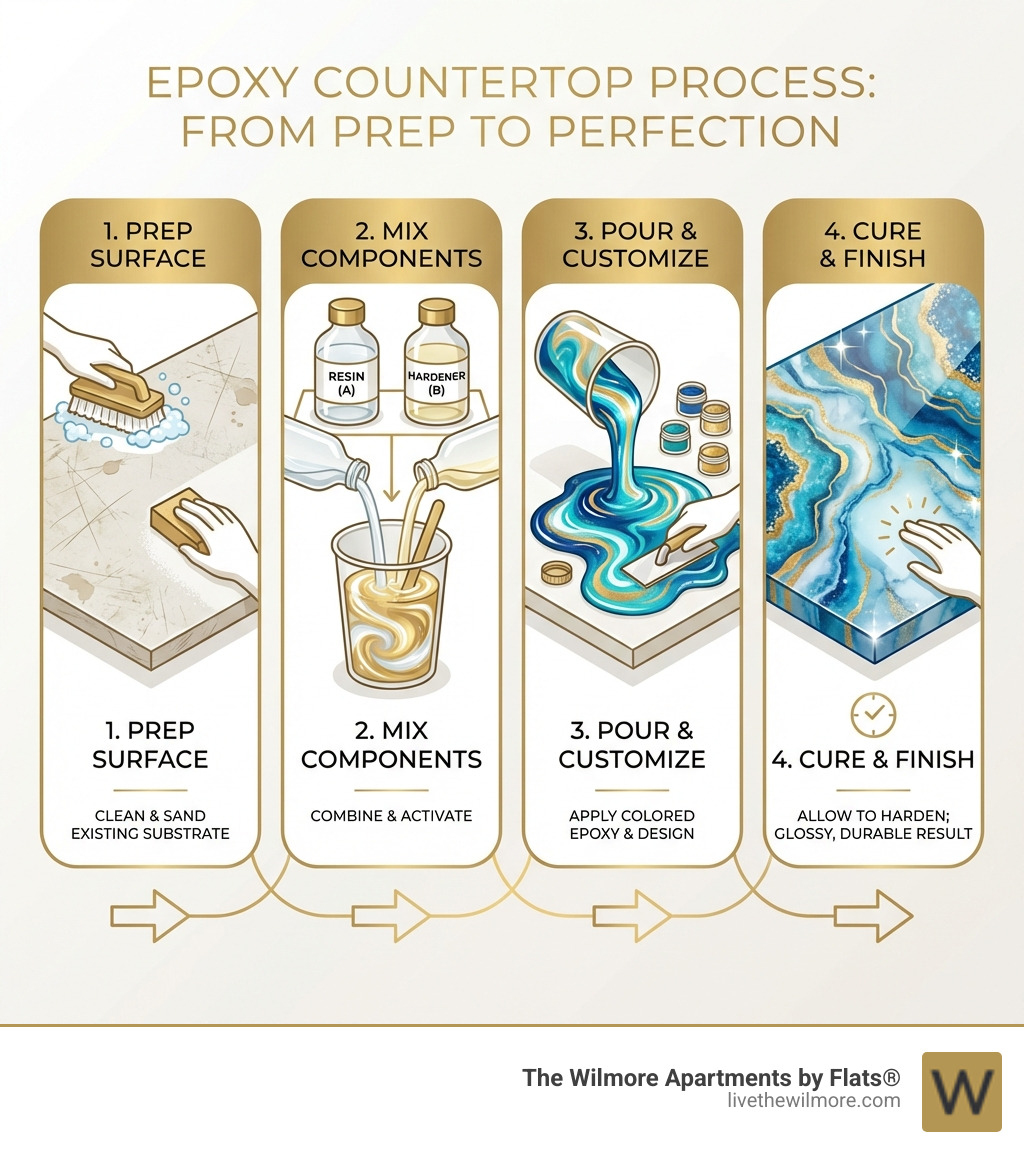
The installation of epoxy resin countertops can be either a detailed DIY project or a task best left to professionals. For those considering a DIY approach, thorough research and adherence to instructions are paramount. The journey begins with meticulous surface preparation. This involves cleaning the existing countertop thoroughly, degreasing it, and often sanding it with coarse abrasive paper (e.g., 120-grit) to create a "key" that the epoxy can bond to. Porous substrates like wood or concrete may also need to be sealed with a "skim coat" of epoxy to prevent air bubbles and ensure proper adhesion.
Next, we might build a mold or dam around the edges of the countertop to contain the liquid epoxy. The critical step is mixing the two-part epoxy resin system—the resin and the hardener. This demands absolute precision in adhering to the manufacturer's specified mixing ratios, whether it's 2:1 by weight for products like GlassCast 3, or other ratios for different brands. Thorough mixing for several minutes, often involving a "double potting" method where the mixture is transferred to a second clean container and mixed again, is essential to ensure a complete chemical reaction and proper cure. As highlighted in many Casting Instructions , incomplete mixing is a common cause of failure.
Once mixed, the epoxy is poured and spread evenly across the surface. During this stage, air bubbles can appear. These are typically removed using a heat gun or a propane torch, carefully waved over the surface to release trapped air, or sometimes with a spray of isopropyl alcohol. After application, the epoxy enters its curing phase. While it may harden to the touch within 12 to 24 hours, full cure, reaching maximum hardness and durability, can take anywhere from 5 to 30 days, depending on the product and environmental conditions. If we are considering pre-made epoxy countertops, the lead time can range from 5 to 14 weeks.
Customization Options for your epoxy resin countertops
The true artistic potential of epoxy resin countertops shines in the vast customization options available. This material allows us to create virtually any look we desire, making each countertop a unique piece of functional art.

We can incorporate a wide array of color pigments, from opaque solids to translucent tints, to match any interior design scheme. The addition of metallic powders introduces a shimmering, pearlescent effect, adding depth and luxury. Techniques like creating veins and swirls with contrasting colors or dragging accent colors with a paint stick can mimic the intricate patterns of natural stone, such as marble or granite. We can even achieve dramatic geode or river-like effects by layering different colors and materials. For a truly unique touch, embedding objects like glitter, coins, or even small keepsakes beneath a clear epoxy layer creates a captivating 3D effect. The key is careful planning and a willingness to experiment with these creative possibilities.
Durability, Maintenance, and Lifespan
Understanding how to care for your epoxy countertop is key to its longevity and lasting beauty, ensuring it remains a stunning feature in your home.
How Durable Are Epoxy Resin Countertops?
Epoxy resin countertops are renowned for their robust nature, offering impressive durability under various conditions. Many high-quality epoxies are formulated to be heat resistant, capable of withstanding temperatures up to 500°F (260°C) for brief or accidental contact, as seen with products like Premium FX Poxy. This means placing a hot pan down momentarily is unlikely to cause damage, though we always recommend using trivets for prolonged heat exposure.
Their scratch resistance is generally considered moderate. While resilient against everyday wear, they are not impervious to deep scratches from sharp objects, so using cutting boards is always a good practice. However, some epoxies, like Premium FX Poxy, boast exceptional impact resistance, being five times stronger than concrete, which adds to their heavy-duty appeal. Modern formulations also often include UV inhibitors to improve UV resistance, helping to prevent yellowing, especially in sunny areas. With proper care and quality materials, an epoxy countertop can last a lifetime, as some manufacturers suggest. While specific warranty information varies by product and installer, the inherent properties of a well-applied epoxy promise a long and functional lifespan.
Maintenance and Cleaning Best Practices
Maintaining the pristine appearance of your epoxy resin countertops is relatively straightforward and crucial for their longevity. For daily cleaning, we recommend using mild soap and water. A soft cloth or sponge is usually sufficient to wipe away spills and grime. For slightly tougher spots, household products like lemon or citrus oil with a 50% vinegar and 50% water solution can be effective. Crystal Simple Green can also be used with a soft cloth. For very difficult spots, acetone might be permissible, but always check the manufacturer's guidelines first. After cleaning, wipe the surface dry with a clean, soft cloth to remove all cleaning residues and avoid water spotting.
It's vital to avoid abrasive cleaners, scouring pads, or harsh chemicals, as these can dull the finish or even damage the epoxy. To protect against heat damage, always use trivets or hot pads for hot pans and dishes. Similarly, always use cutting boards to prevent scratches from knives and other sharp utensils. Perhaps the most important rule for epoxy maintenance is to clean spills immediately. While the surface is non-porous, certain substances, especially dark or acidic liquids, can still leave marks if left for too long. If you notice any dullness over time, a small amount of Murphy’s Oil or mineral oil applied with a clean rag and buffed with a chamois cloth can help restore its shine.
How Epoxy Compares to Other Countertop Materials
Epoxy resin countertops offer a unique alternative to traditional materials like quartz and granite, each with distinct characteristics that cater to different preferences and needs.
Epoxy vs. Quartz
When we compare epoxy and quartz, we see two very different approaches to countertop design and functionality.
| Feature | Epoxy Resin Countertops Superclear® Countertop Epoxy is food grade compliant and UV resistant.
- Superclear® Countertop Epoxy cures to a high heat resistance and is scratch resistant.
- The Superclear® Countertop Epoxy has a long working time due Superclear® Countertop Epoxy has a long working time due to its low viscosity formulation.
Maintenance and Cleaning Best Practices
To ensure your epoxy resin countertops remain beautiful and functional for years, a regular maintenance routine is essential. We recommend daily cleaning with mild soap and water, using a soft cloth or sponge. For more stubborn spills or marks, lemon or citrus oil mixed with a 50% vinegar and 50% water solution can be quite effective. Products like Crystal Simple Green can also be used with a soft cloth. In cases of very difficult spots, acetone might be an option, but always check your product's specific guidelines first. After cleaning, dry the surface thoroughly with a clean, soft cloth to prevent water spots.
Crucially, avoid using abrasive cleaners, scouring pads, or harsh chemicals, as these can dull or damage the epoxy's glossy finish. To protect against heat, always place hot pans, dishes, or appliances on trivets or hot pads. Similarly, always use cutting boards to prevent knives and other sharp objects from scratching the surface. Prompt cleanup of spills is paramount; while epoxy is non-porous, highly pigmented or acidic liquids can still leave stains if left to sit. If you notice the surface losing some of its luster over time, a small amount of Murphy’s Oil or mineral oil applied with a clean rag and buffed with a chamois cloth can help restore its original shine.
How Epoxy Compares to Other Countertop Materials
Epoxy resin countertops offer a unique alternative to traditional materials like quartz and granite, each with distinct characteristics that cater to different preferences and needs.
Epoxy vs. Quartz
When we consider epoxy resin countertops alongside quartz, we're looking at two very different approaches to surface design and functionality.
| Feature | Epoxy Resin Countertops | |
|---|---|---|
| Design Flexibility | Unlimited; any color, pattern, or effect possible. Can be created over existing surfaces. | Consistent, usually uniform patterns. Limited color and pattern choices compared to epoxy. |
| Durability | High heat and corrosion resistance. Moderate impact resistance. Some products are scratch-resistant. Can yellow with UV over time. | Highly scratch-resistant, non-porous, stain-resistant. Good heat resistance. Very durable. |
| Heat Resistance | Up to 500°F (260°C) for brief contact. Consistent use of trivets recommended. | Excellent heat resistance, though extreme temperature changes can cause damage. |
| Maintenance | Easy to clean with mild soap and water. Prompt spill cleanup critical. Avoid abrasives. Superclear® Countertop Epoxy has a long working time due to its low viscosity formulation. |