


Why Quartz Countertop Benefits Make It the Most Popular Surface in Kitchens Today
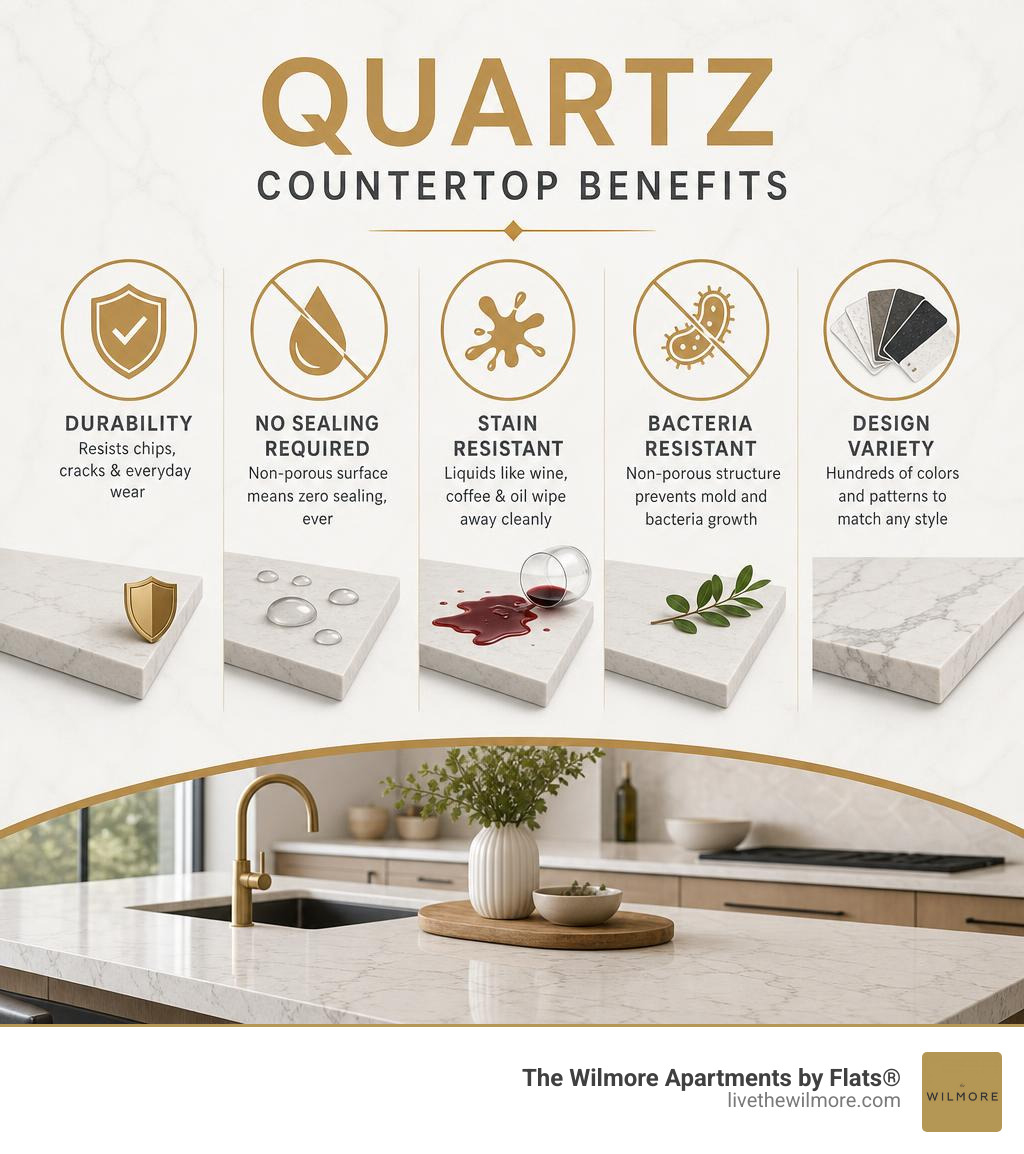
Quartz countertop benefits include a combination of durability, low maintenance, stain resistance, and design flexibility that few other surfaces can match. Here's a quick summary:
- Durability - Rates 7 on the Mohs hardness scale; resists chips, cracks, and everyday wear
- No sealing required - Non-porous surface means zero sealing, ever
- Stain resistant - Liquids like wine, coffee, and oil wipe away cleanly
- Bacteria resistant - Non-porous structure prevents mold and bacteria growth
- Design variety - Available in hundreds of colors and patterns, including marble and granite looks
- Low maintenance - Mild soap and warm water is all you need
- Long lifespan - With proper care, quartz can last 25 to 50+ years
Countertops are one of the most-used surfaces in any home. They take daily punishment — hot pans, sharp knives, spilled coffee, and heavy appliances.
So choosing the right material matters a lot.
Quartz has become the most popular countertop material in the US, accounting for over 30% of all countertop installations. That's not a coincidence. It's an engineered stone made from roughly 90–94% natural quartz crystals bound with polymer resins — a combination designed to outperform natural stone in the ways that matter most to busy households.
At The Wilmore Apartments by Flats® in Uptown Chicago, quartz countertops are part of what makes the kitchens feel genuinely elevated. This guide breaks down everything you need to know — from how quartz is made, to how it stacks up against granite and marble, to what trends are shaping kitchen design in 2026.
What is Engineered Quartz?
To appreciate the many quartz countertop benefits, it helps to understand what this material actually is. Unlike granite or marble, which are quarried directly from the earth as solid blocks, quartz countertops are an engineered stone.
The manufacturing process of engineered quartz is a marvel of modern engineering. It relies on advanced Breton technology, a specialized production method developed in Italy. Raw natural quartz crystals are mined, crushed into various sizes, and then combined with polymer resins, pigments, and other additives.
This mixture is poured into a mold, compacted under massive vacuum pressure (often exceeding 100 tons), and then cured in a heated kiln. The result is an incredibly dense, solid slab that is completely uniform in structure.
Because it is engineered, manufacturers can control every detail of the final product. If you want to dive deeper into the technical standards and structure of this material, you can read the What is Quartz Countertops? Structure, Performance & Industry Standards Explained (2026 Guide). At the end of the day, this careful manufacturing process is what places quartz at the top of the list for Luxury Countertop Materials.
Understanding the Composition of Engineered Stone
The scientific composition of a standard quartz slab is typically around 93% natural quartz mineral and 7% polymer resin binders and color pigments. This ratio is the secret behind the material's success.
The high concentration of natural quartz—which is one of the hardest minerals on Earth—gives the countertop its raw strength. Meanwhile, the 7% resin acts as a high-performance binder, filling every microscopic void.
This creates a completely non-porous structure. Unlike natural stones that are riddled with microscopic pores, fissures, and capillary channels, engineered quartz has a uniform slab density. This means liquids cannot penetrate the surface, resulting in exceptional visual consistency and structural integrity across the entire slab.
Key Quartz Countertop Benefits for Modern Kitchens
When we design spaces in Chicago, we look for materials that can stand up to real life without requiring a part-time maintenance schedule. The quartz countertop benefits speak directly to this philosophy. By combining raw mineral strength with engineered polymers, quartz solves almost every daily frustration associated with traditional kitchen surfaces.
For a comprehensive look at how these advantages translate to daily life, explore the Advantages of Quartz Countertops | Top Benefits Guide. It becomes quickly apparent why quartz is consistently ranked among the most Durable Countertop Options for modern homes.
Unmatched Durability as One of the Key Quartz Countertop Benefits

The primary reason homeowners and designers choose quartz is its sheer, uncompromising durability. Quartz rates a 7 on the Mohs hardness scale. To put that in perspective, a diamond is a 10, and steel is typically around a 5 or 6. This means quartz is harder than your kitchen knives.
This hardness translates into incredible chip resistance and impact strength. In high-traffic areas like a busy kitchen island, accidental bumps from heavy cast-iron pans or grocery bags can easily chip softer stones like marble. Quartz handles these daily impacts with ease. The polymer resins provide a touch of flexibility that natural stones lack, making quartz far less prone to cracking under sudden impacts.
Low Maintenance: A Major Highlight of Quartz Countertop Benefits
Perhaps the most celebrated daily benefit of quartz is how incredibly low-maintenance it is. Natural stone surfaces like granite and marble require periodic sealing—often once or twice a year—to keep them from absorbing liquids and staining. If you forget to seal them, a spilled glass of red wine or a splash of olive oil can permanently ruin the stone.
With quartz, sealing is a thing of the past. Because of its non-porous surface, it never needs to be sealed, waxed, or reconditioned.
Daily cleaning is as simple as wiping the surface down with warm water and mild soap. You don't need specialized stone cleaners or chemical sealants. To learn more about how simple it is to care for these surfaces over the long run, check out the Quartz Countertops Buying Guide 2026 | BELLASTONE. For a broader comparison of how this upkeep compares to other surfaces, browse the Best Countertop Materials Guide 2026.
Quartz vs. Natural Stone: A Performance Comparison
Choosing between quartz and natural stone often comes down to weighing performance against natural variation. To help you visualize how these materials stack up, we have put together a head-to-head comparison:
| Performance Metric | Engineered Quartz | Natural Granite | Natural Marble |
|---|---|---|---|
| Sealing Required | No (Never) | Yes (Every 1-2 Years) | Yes (Every 6 Months) |
| Stain Resistance | Excellent (Non-Porous) | Moderate (Porous) | Poor (Highly Porous) |
| Scratch Resistance | Excellent (Mohs 7) | Very Good (Mohs 6-7) | Fair (Mohs 3-4) |
| Heat Resistance | Moderate (Up to 300°F) | Excellent | Good |
| Acid Etching | Highly Resistant | Resistant | Extremely Vulnerable |
| Visual Consistency | High (Controlled) | Low (Natural Variation) | Low (Natural Variation) |
While granite is an exceptional material, especially for elements like a Granite Kitchen Island, quartz edges it out for homeowners who want a worry-free surface. Granite is a 100% natural igneous rock that handles high heat beautifully, but it remains porous and requires regular maintenance.
Marble, though stunning, is highly vulnerable to acid etching. A simple squeeze of lemon juice or a drip of vinegar can permanently dull marble's polished finish. Quartz resists these acidic reactions entirely. For a detailed breakdown of this rivalry, read Quartz vs. Granite Countertops: Which Is Right for You? Pristine K&B.
Quartz vs. Quartzite in 2026
It is incredibly common to confuse quartz with quartzite, but they are entirely different materials. Quartzite is a natural metamorphic rock that begins as quartz-rich sandstone. Under intense heat and pressure deep within the earth, it recrystallizes into an extremely hard natural stone.
| Feature | Engineered Quartz | Natural Quartzite |
|---|---|---|
| Origin | Manufactured (93% mineral, 7% resin) | 100% Natural Stone |
| Sealing | No sealing required | Requires sealing every 1-2 years |
| Aesthetics | Consistent, predictable patterns | Wild, unique, natural veining |
| Heat Limits | Up to 300°F (due to resins) | Highly heat resistant |
While true hard quartzite is scratch-resistant and doesn't etch from acids, it is still a natural stone and requires regular sealing to prevent stains. For those looking at natural stone alternatives in 2026, quartzite represents a premium, low-etch choice, which you can read about in the design analysis Quartzite Countertops in 2026 | The Quiet Choice | Citadel – Citadel Spaces. However, for absolute ease of care, engineered quartz remains the champion.
Design Trends and Limitations of Quartz

In 2026, quartz design has reached new heights of realism. Thanks to advanced 3D vein printing technology, manufacturers can now create slabs with deep, hyper-realistic veining that goes all the way through the thickness of the stone. This allows quartz to convincingly replicate high-end Italian marbles like Calacatta and Carrara without the delicate maintenance.
Current trends favor warm neutrals, soft greys, and matte or honed finishes over the high-gloss polished look of the past. These softer textures bring a tactile, organic feel to a Sleek Kitchen Design.
However, to make an informed decision, you must also understand the limitations of quartz:
- Heat Sensitivity: The polymer resins that bind the quartz crystals together are sensitive to extreme heat. Placing a pot straight from the stove onto a quartz surface can cause the resin to discolor, warp, or even crack if temperatures exceed 300°F. Always use trivets or hot pads.
- UV Discoloration: Quartz is designed strictly for indoor use. The resins used in the slabs react to ultraviolet (UV) light, which can cause the material to yellow, fade, or warp over time if exposed to direct sunlight.
- Weight: Weighing between 20 to 25 pounds per square foot, quartz is incredibly heavy. It requires professional installation and sturdy, well-leveled cabinetry to support its weight.
For a deep dive into these design possibilities and technical boundaries, explore the Quartz Countertops Guide 2026 | Complete Info | SlabWise.
Frequently Asked Questions about Quartz Countertops
What factors should be considered when selecting quartz countertops?
When planning your kitchen design, several factors will influence your selection and installation process:
- Material Grade: Standard, solid-color slabs are highly versatile, while premium slabs featuring intricate, marble-like veining or specialty finishes (like leathered or honed) offer a more customized look.
- Complexity of Installation: The number of cutouts needed for sinks, cooktops, and electrical outlets, as well as the complexity of the edge profiles, will influence the fabrication and labor requirements.
- Slab Thickness: Choosing a thicker slab (such as 3cm, which is standard for luxury applications) provides a more substantial presence compared to a thinner 2cm slab.
To learn more about what goes into planning these projects in the local market, you can reference the Quartz Countertops Guide (2026).
Do quartz countertops increase home resale value?
Yes, absolutely. High-quality countertops are one of the most sought-after features for modern home buyers. According to data from the National Association of Realtors, kitchen upgrades consistently yield some of the highest returns on investment (ROI) for home renovations.
Because quartz is highly recognizable as a premium, durable, and low-maintenance luxury finish, it dramatically boosts buyer appeal. Buyers appreciate that they won't have to worry about the immediate maintenance or replacement hassles associated with worn-out laminate or stained natural stone.
How do you clean and maintain quartz countertops?
Keeping your quartz looking brand new is incredibly simple. For daily cleaning, use a soft cloth or sponge with warm water and a few drops of mild dish soap.
To preserve the surface, avoid the following:
- Harsh Chemicals: Never use bleach, oven cleaners, highly alkaline cleaners, or abrasive scouring pads (like steel wool), which can dull the polished finish or break down the polymer resins.
- Direct Heat: Do not place hot pots, pans, or baking sheets directly on the surface.
- Using It as a Cutting Board: While quartz is highly scratch-resistant, cutting directly on it can dull your knives and potentially leave metal marks on the stone.
Conclusion
When you look at the complete picture, the quartz countertop benefits make it clear why this engineered stone has taken over the design world. It offers the timeless, high-end beauty of natural stone while eliminating the stress of constant sealing, delicate cleaning routines, and accidental staining. It is a material built to handle the beautiful chaos of daily life.
For residents in Uptown Chicago, this balance of luxury and practicality is exactly what defines the living experience at The Wilmore Apartments by Flats®. Our beautifully designed apartments feature gorgeous quartz countertops that serve as the functional centerpiece of our modern kitchens.
If you are ready to experience a home designed around how you actually live, explore our available Apartments with Quartz Countertops and find your perfect space in the heart of Chicago today.